0 views today · 269 views all time
Electric Charge-Cooler Pump
The Lotus Esprit has a charge-cooler fitted between the exit of the turbo and the inlet manifold. Its purpose is to reduce the air temperature of the charge going to the engine.
Air expands greatly when its temperature is increased; in any engine, the hotter the charge inlet temperature, the less efficient the engine is working. This also has the knock-on effect of increasing the temperature of the exhaust gas.
When the engine is receiving hotter than normal air, the ECU will reduce the timing and boost pressure because there is an increased danger of detonation or pinking occurring.
The Esprit is fitted with an extra radiator (it's a modified refrigerator condenser) at the front of the car that is part of a separate charge-cooler circuit. The water in this circuit is pumped around by an engine mounted mechanical pump. This pump always fails. If your car has driven more than 15,000 miles, it's probably got a broken charge-cooler pump.
How Do I Know If My Pump Is Broken?
Well, you don't really know. If you go out for a longish journey, the charge-cooler case will be cool to touch. A more scientific approach is to connect a scantool such as that excellent FreeScan program ;-) and check what the MAT sensor is reading during a journey.
It should read not much more than ambient, approximately 5 to 10 degC more. Mine was reading 53 degC.
The best test is to go out for a run in the car and park it with the engine off. Wait 15 minutes and the charge-cooler will heat up (because it's on top of the engine!). Connect FreeScan and you'll see a reasonably high MAT reading. Go out for a journey and after a few minutes, depending on your road speed, the MAT should start to reduce. If it does not, your charge-cooler pump is probably knackered.
Options
You have two options:
- Buy a charge-cooler pump repair kit and amaze yourself with the gynaecologic positions you can get your arms in just to get at the original pump, let alone re-fit it... or
- Fit a new, wizzy electrical pump.
Most people choose the former option. I chose the latter one... because:
- It's a damn-sight easier to fit,
- The pumping capacity of an electric pump is far superior to the mechanical original,
- It's easier to check it's working because you can hear the water being pumped through the system,
- It's not a standard Lotus part and you can boast about it to your friends.
What's Needed
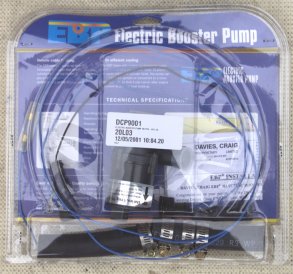
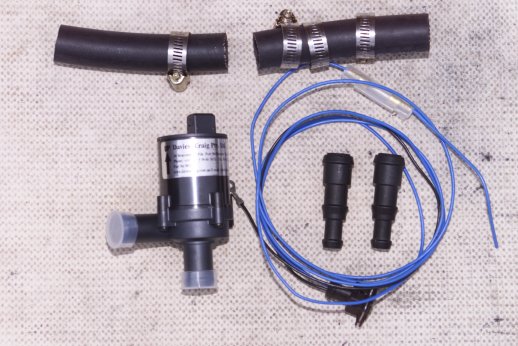
The EBP electric booster pump is an Australian made device. It's available in the UK and by mail-order from Demon-Tweeks, Wrexham, Wales, UK. Their web-site is at http://www.demon-tweeks.co.uk/ where you can order on-line.
Installation
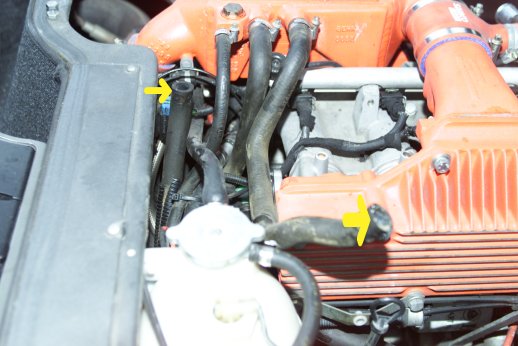
The most difficult part of the procedure is removing the original hoses from the existing charge-cooler pump. Removing the air-filter box may help you here.
Remember to loosen the hose clips as much as possible. Pull the hose that attaches to the charge-cooler first and then the hose that runs under the coolant header tank to the front of the car. The hoses are arrowed.
Re-route the hose that runs under the coolant header tank as shown below (left in the picture).
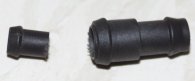
The electric booster pump comes with two hose adapters. You need to hack-saw the smaller end off. The hole running through the body also needs enlarging with a round file.
Warm the coupling hoses up for at least 5 minutes in boiling water to make them pliable enough to work with.
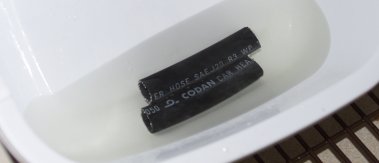
Cut the hoses to length and attach the adapters to the electric booster pump.
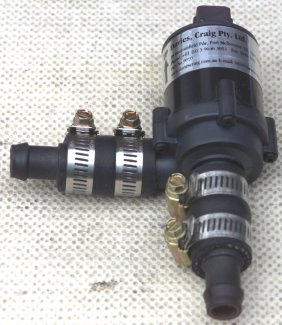
Fit the pump to the lower hose as shown.
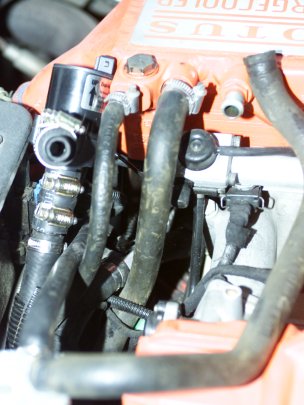
Then connect the other hose to connect the pump to the charge-cooler.
Flushing the System
Connect a garden hose-pipe to one of the pipes and force water through the system. When the water is clear, switch off the pipe and blow down the hose until the system is empty again. Refill with the hose-pipe once again. If the water is discoloured, repeat the above procedure.
Bleeding the System
What an awful, time consuming job this is. The pump needs a head of pressure allow it to work, the standard arrangement of filling is just not good enough,.
I suggest that you cut the bottom of a plastic bottle and, via various pieces of hose, make an adapter to allow you to make a water-tight seal with the charge-cooler's fill point.
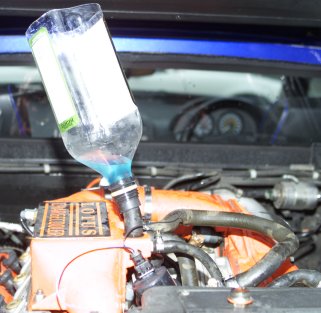
Remove both large hoses from the charge-cooler and blow through one of them to empty it. Refit the hoses.
Fill the plastic bottle full with neat anti-freeze. Massage the charge-cooler circuit's hoses until no air can be see bubbling up into the bottle. Remember to keep the bottle topped up with anti-freeze.
Temporally connect the pump up to the battery and let it run for 10 minutes. You should hear the pump working against the water in the system. This will be accompanied by bubbles appearing in the plastic bottle.
Again, massage the hoses to assist in removal of air in the system.
You must understand that, apart from the expansion hose, there is no connection to the engine's cooling system; the two water circuits are completely separate.
Bleeding the system will take about an hour. It may help if you start the engine as the higher temperature and vibration will force more air out.
Finished Job
The following pictures show the finished installation, apart from the wiring. The pump is held in place by two tie-wraps.
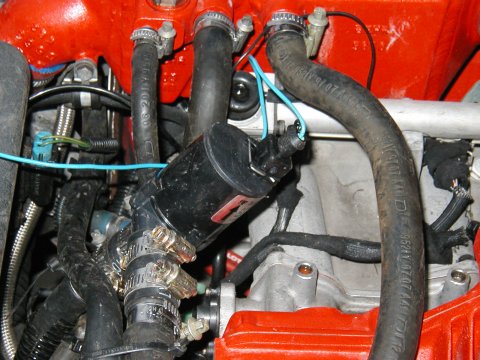
The pump looks quite at home in this position.
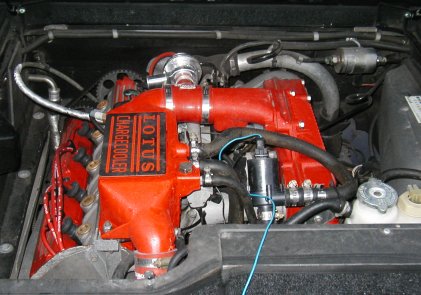
With the engine cover fitted, the pump just sticks out but, more importantly, misses fouling the cover.
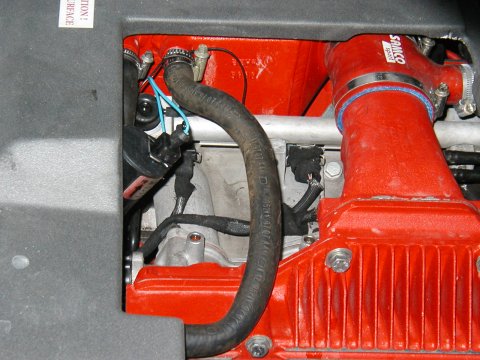
Have fun!
Andy.
Times page accessed since August 2001:
Page created by: mail@andywhittaker.com
Changes last made on: 18 May 2002 16:19 -0400